Archive for August, 2012

Dim Sum

Posted in Food, Travel with tags , , , , , , on August 31, 2012 by David McInerny

I first encountered dim sum in San Francisco’s Chinatown about a dozen years ago with Jeff, a colleague then, and still a great friend now. Cantonese dim sum is a style of meal roughly equivalent to eating a selection of appetizers, or to the Spanish tapas, the Brazilian churrascaria, or the Dutch reistafel. It’s a simultaneous offering of small tidbits of varying flavors, textures and levels of spiciness. It’s not expected to make a meal out of one or even two dishes, but to take a taste of many choices, each served on a small plate.

In a casual Chinese storefront shop, usually run by a husband and wife team, you walk up and point to four or five items that look enticing, and the choices will be placed on a plastic tray, which you’ll take to a small table on the sidewalk to enjoy. This is as close to “fast food” as you’ll see in Asia, though they still shun the “drive-thru” option. In finer dim sum restaurants, you are seated inside, girls push trays of dim sum around the dining room, and you stop them and choose items as they pass by.

A typical dim sum meal would consist of dumplings with spicy pork filling, beef ribs chopped into bite size pieces, cabbage and carrots sauteed in peanut oil, chicken wings in brown sauce, bits of calamari with chili pepper, steamed baby corn with ginger, and white or fried rice. Traditional beverages would include hot green tea and cold beer. I particularly like the Dutch variation, whereby all the dim sum choices are eaten out of the same bowl, and at the end of the meal a dollop of white rice is mixed in with all remaining sauces from the dim sum for a final blast of flavor.

Tour d’Eiffel

Posted in Fiction, Travel with tags , , on August 30, 2012 by David McInerny

The Eiffel tower rose into a warm hazy sky of gunmetal gray.  The structure itself was at the same time mechanically businesslike yet still endowed with a grace that emanated from its curves that extend from the four massive bases before it becomes unified and thrusts phallic-like into the haze.  Make no bones about it – it is large.  It dominates that entire section of Paris, a colossal contrast to the 19th century brick buildings and stone streets that run perpendicular from the quadrangle that the Eiffel Tower is anchored within.  Photographers like us quickly learned that they would need to back a thousand yards away if they wanted to capture the entire edifice in the frame.  As we came upon the nearest base, containing one of four ticket windows, sets of stairs and elevators, we slowed to merge with the gathering crowd which united with the large crowd already in line.  I sighed as quietly as I could.  Truthfully, I would have been more than satisfied to ponder the marvels of the Eiffel Tower from a distance, as part of the Parisian skyline, leaving the treasures of the summit to a future visit, if ever.  It simply struck me as time consuming, hot, crowded, and a waste of money.  Such a notion was inconceivable to the three kids, though, so I knew better than to try to dissuade them from the crowds and peddlers, let alone the cost required to get a family of five lofted into the bowels of this beast of French eclecticism.  So we got ourselves in line, bottles of water priced like champagne shoved in our faces as the buzz –clink of the toy birds dived bombed around us.  Soon, we realized a decision would need to be made.  Would we climb the old fashioned way or take the unsettling 45-degree elevator?  My wife made a bold move, and I applauded her for it.  Under no circumstances, she declared, would she be making for the top.  Bully for you dear, I encouraged silently, if not a little cowardly.  One of our sons agreed, that he would not want to go up all the way, but at least to the first main level.  The other two still had the idea of the tippy-top in their heads, so we concluded that we would take the stairs to the first level, and gauge the situation from that height.

My wife and older son stayed on the first main level, having watched the ground slowly recede below them through the open stairs and deciding that enough was enough.  They chose to reward their efforts with strawberry ice cream cones and a tour of the restaurant and post office.  I would have been quite satisfied to join them, but we still had two that wanted to go higher.  The stairs accommodated those going up and down, and some, whether climbers or descenders, chose the inside part of the open stairwell in order to grasp some psychological sense of greater safety.  It made for some interesting traffic jams, though.  This time the height slowed my two down as well, but they bravely persevered to the next level that, though a much tighter space than the level below, still provided a 360-degree walk-around.  The climb to the top was jettisoned as my son and daughter both decided that the panorama here was sufficient for picture taking.  I had to admit that the view of the Seine and museum row was magnificent, as was the brilliant whiteness of the Sacre Cour.  We lingered a bit to gain our composure for the trip back down, but the thought of ice cream steeled us for the return journey.

In making our way to the Arc du Triomphe, we stumbled across the Shangri La of high end, boutique shopping.  One look in my fair bride’s eyes and I saw that she was longing for that Parisian purchase which would make her friends’ eyes grow wide with awe.  The string of stores along the Rue Montaigne would make even the most Rodeo Drive -hardened shopper grow a little weak in the knees. There, displayed before us, were shops represented by every luxury designer under the sun.  In fact it was along Rodeo Drive in L.A. that I had seen this look from my wife before, and it had gone unsatisfied.  The kids trotted along ahead of me thinking of lunch, as my wife lingered behind me, wistfully dreaming of Fendi.  I needed to make a decision fast and, as we turned onto the Champs Elysees and quickly came upon the Louis Vitton store, so I rounded up the kids and told them that we were going to let Mom wander in this store a bit, and then we would eat lunch.  With a smattering of moaning from our youngest, and a luxurious sigh from the adult feminine one, we entered the Paris hub of all that is LV.

I have since learned that counterfeit bags are a particular problem for these designer firms, and I instantly saw why.  Ridiculously thinking that I would chuckle as we spent twice, dare I say three times the price of a department store purse for a Louis Vitton equivalent, I was as stunned as the bovines who gave their all to make these branded masterpieces when I saw the prices.  The smallest coin purses required an investment that would have been a solid down payment for a luxury automobile.  The sales people, mostly men in suits that would not have been out of place in the solemn boardrooms of elite Wall Street financial institutions, merely nodded as we entered, giving us free reign to stare at the merchandise in wonder, or horror, depending on one’s outlook.  The goods were displayed like the treasures of an Egyptian pharaoh, under glass with spot lighting to accentuate each item’s individual accoutrements.  Price tags, large enough to accommodate the requisite number of zeros, were unabashedly displayed next to each item.  I was baffled.  I saw these bags commonly on the arms of women all over America and Europe.  How could people afford these, I asked my salivating bride.  Many, if not most of them are not real, was her quick response.  How as one to tell?  There are ways, she murmured, not to be dissuaded from the real McCoy.  Nor would I want to try.  I must confess to my relief, however, that she knew well before walking into the boutique, as I never could have anticipated, that only the budget of the privileged few could withstand the spontaneous purchase of a Louis Vitton purse.  She was patient to window shop that day, and give me the opportunity, upon our return to the States, to arrange for less eating for a month or two to accommodate the purchase of a modest bag from the LV website as a Christmas gift that year.

We were all beginning to flag, and our youngest was absolutely ravenous, so we turned onto the Champs Elysees in search of a quick lunch.  The wide, airy avenue is beautifully tree lined, and it provided cool respite from the heat of the Eiffel Tower.  There were adequate opportunities for dining, but I was fearful of the tourist’s nightmare – bad food pictured in photos at the door with mediocre service and prices set to empty the wallet of the unwary traveler.  On the other side of the spectrum, noticing the tables set outdoors with linen and well groomed waiters whisking in and out of the restaurant with cold beer and steaming plates, I knew this was no time for a top-notch meal for the mental scrapbook.  No, as the kids (and I) started to pant our way along, I knew that this was a time for basic food, hearty and fast.  We spied a simple shop with hamburgers, hotdogs, cold pop and (oh, how I love Europe) cold beer.  When Nancy discovered that the tables outside belonged to the shop, I knew I had a happy family.   Moments later the kids were diving into recognizable American food, notwithstanding the hot dog’s French origin, and the fries’ first name.  In fact, my wife and I were marveling over the deliciousness of the French fries, which were a meal in themselves.  We all people-watched for an hour as we munched and sipped our drinks.


Traveling with Papa Hemingway

Posted in Books, Food, Travel with tags , , , , , , , , on August 29, 2012 by David McInerny

I don’t deliberately plan to take family and friends to global Ernest Hemingway haunts, but the great author was so well traveled, it’s hard not to cross his path. I will admit, though, once a vacation spot is chosen, and I know Papa spent time there, he becomes part of the vacation itinerary.

La Pepica was Hemingway’s favorite restaurant in Valencia, Spain. When I took the family to Valencia to celebrate Christmas in 2008, we walked one night from our apartment to the seaside to enjoy dinner at La Pepica. A wall-sized photo of Papa eating at the restaurant dominates one of the several rooms that face the ocean, and we enjoyed a hearty meal of seafood and rice.

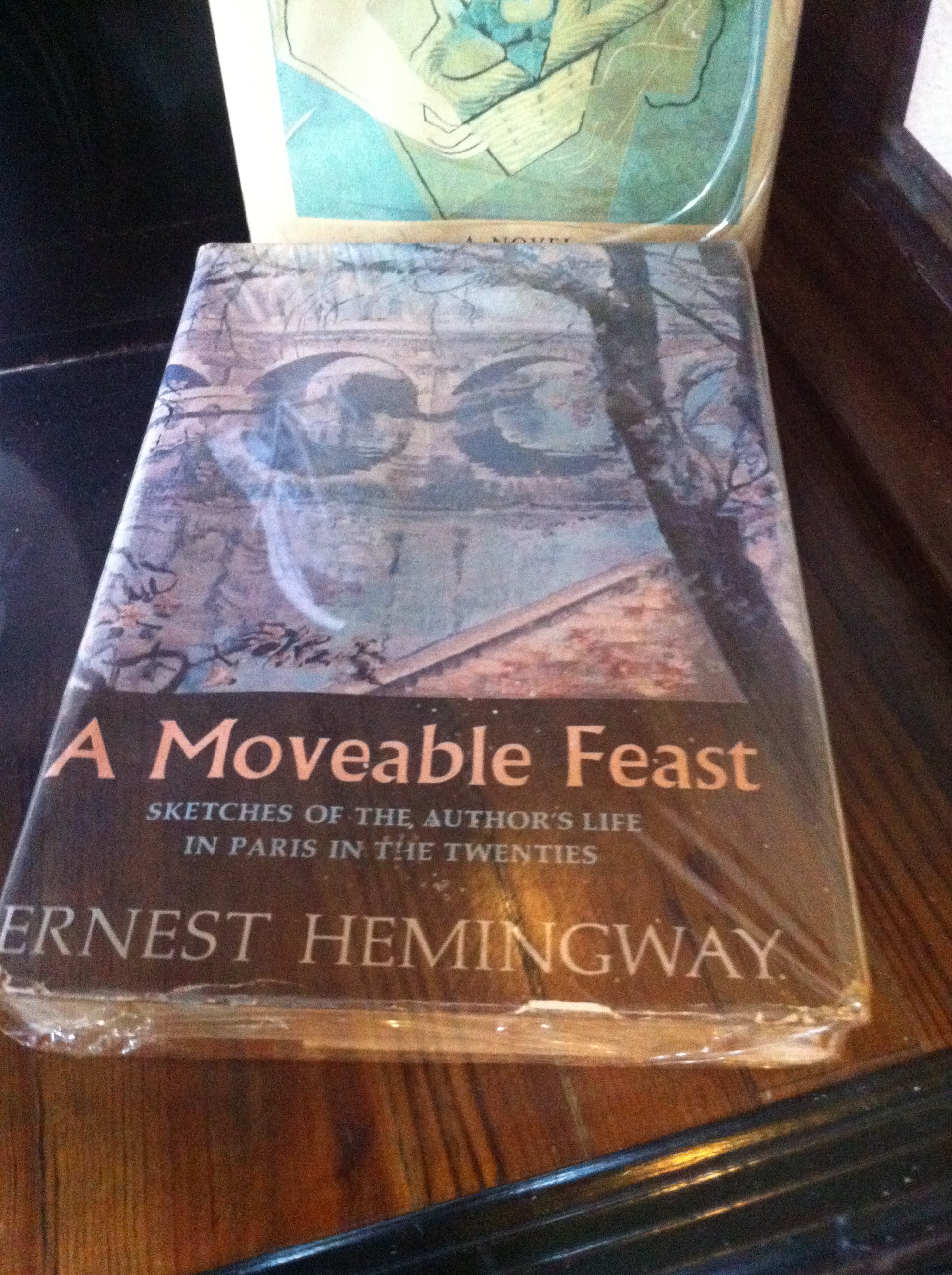
Hemingway started his career of writing fiction as one of the Lost Generation living on the Left Bank of Paris. When our cooking club flew to Paris in 2010, the group was kind enough to allow me to reserve a hotel on the Left Bank so we could walk the same streets, eat croissants at the same cafes, and peruse the same wooden bookstalls along the Seine that Hemingway did. A Movable Feast is a mesmerizing memoir of Papa’s time in Paris with the other soon-to-be-famous writers of the Lost Generation. I highly recommend it, and it was quasi-required reading for our group on that trip.

Last year, the cooking club spent a long (rainy) weekend on Key West. During a short break from the tropical depression that refused to move on, we rented bikes and rode into town to shop, have lunch, and see Hemingway’s home there. Looking at his book collection, I was delighted to see that he was a fan of Georges Simenon too, and I loved his writing room, complete with mounts from his African hunts.

I own all of Ernest Hemingway’s works, and have read many of them. A first edition copy of For Whom The Bell Tolls is a highlight of my personal library. My favorite novel of his is The Sun Also Rises; in fact, in my opinion it is  the greatest novel ever written. Reading it should be on your bucket list.

Closet Bands (Shhhh!)

Posted in Music with tags on August 28, 2012 by David McInerny

I’m a serious music lover. I listen to jazz, classical, rock, pop, and I’m warming up to western. I have attended countless Dead concerts, and have subscribed to the symphony for decades. I saw Dave Brubeck at Orchestra Hall in Chicago, which was a highlight of my musical life. But … between us girls, I also have a long list of “closet bands,” meaning bands I love that I would never reveal to my boss, at the local biker bar, to my tax preparer, to the guys on the bowling league, and certainly never, ever, to my great musical friend Tom, who comments at will on this blog, God love him. Until now! Look for his warranted barrage after this is posted. 🙂

Here are my Top 10 closet artists:

  1. Electric Light Orchestra (“strange magic”)
  2. Toto (“love isn’t always on time”)
  3. Madonna (“borderline…”)
  4. Styx (“you’re an angry young man”)
  5. Journey (“don’t…stop…believing”)
  6. Frankie Goes To Hollywood (“relax, don’t do it”)
  7. Sade (“smooth operator”)
  8. Michael McDonald (“keep forgettin’ that you don’t love me no more”)
  9. Liberace (I held a Liberace appreciation party – no kidding! It was well attended!)
  10. America (“muskrat susie, muskrat sam”)

Pesto-encrusted Chops

Posted in Food with tags , , , on August 27, 2012 by David McInerny

There’s nothing to this entree, and it’s perfect for autumn. First, cut up some red russet or yukon gold potatoes into a casserole pan with olive oil and roast, covered, in a 350 degree oven for fifty minutes. Meanwhile, make a small amount of pesto – one rounded tablespoon per chop (easy recipes abound online – fresh basil, garlic, parmesan, pine nuts (or walnuts), olive oil and a blender).

Grill your chops until they are almost done. Spoon and spread pesto on top of each chop, and cover the grill for five minutes, until the pesto just begins to bubble and brown. Ten minutes before the potatoes are done, stir in chopped fresh rosemary, salt, pepper, and a dash of red pepper flakes.

A quick vegetable side is grated fresh carrots seasoned with pepper, parsley and olive oil. It’s nice to grate ahead and refrigerate. This is a wonderful meal with lean protein, an arsenal of vitamins, and complimentary flavors and textures. Serve with a light Rhone red wine and sparkling water.

John D. MacDonald – Travis McGee Mysteries

Posted in Books with tags , , , , on August 26, 2012 by David McInerny

In twenty-one mysteries written over as many years, John D. MacDonald may have created the most riveting unlicensed private investigator in American suspense writing. Beginning with The Deep Blue Goodbye (1964), and ending with The Lonely Silver Rain (1985), Travis McGee worked as a “salvage consultant,” helping friends-of-friends recover what had been illegally or quasi-legally stolen from the them – for half the value of the item stolen. McGee was the last resort, so after the victims had exhausted every traditional route to recovery, or wished to avoid the legal route entirely, keeping half the value of what they had lost sounded better than recovering nothing at all.

Travis McGee’s past remains cloudy throughout the series – he’s of indeterminate age, and parents and a brother are all the family that are referenced, albeit never in detail. He seems to have been raised in the Midwest, but disdains “states that begin with an I.” He fought in the Army, but we are left to assume he fought in the Korean War. Never married, as far as we know. He’s tall, deeply scarred, deeply tanned, with gray-blue eyes and unruly sandy-blonde hair. He lives on a houseboat on Bahia Mar, Ft. Lauderdale, only working when he has to, preferring to enjoy  his retirement in stages, whenever the cash is adequate.

To say that Travis’ methods are unorthodox is an understatement to the extreme, and his investigative style is the essence of why MacDonald’s creative writing skill is so widely acknowledged. Short of exterminating innocents, McGee rarely hesitates to do whatever is necessary to make a recovery for a client and a chunk of retirement for himself – but he is no automaton. He surprises himself with his need to live close to the edge of death, and often questions the reckless methods he uses to expose a thief. While steadfastly refusing a existence that includes a wife, a mortgage, kiddies and church, he also never quite convinces himself that his lifestyle is not a vacuous, moral fraud. With rare exceptions, McGee will turn away women, even the beautiful, famous and wealthy ones, who view sex as purely recreational, but there is always room aboard the Busted Flush, his beloved houseboat, for a member of the fairer sex with a broken wing in need of healing, and who views intimacy as a chance to transcend the essential void of loneliness.

Yet no wimp is Travis. He’s built like an offensive tackle, but moves like a linebacker, and is as crafty as a pro quarterback. He takes on organized crime, crooked CEO’s, swamp rats, and professional con men. He’s equally comfortable sweating through a crafty interrogation as saying hello by busting a knee. Within the first pages on Chapter One of each of the books, MacDonald has McGee thinking fast to stay alive, and the action rolls through each story to an unexpected, smartly crafted ending.

If you read one Travis McGee, you will read them all, several times. The greatest crime writers of our time credit McDonald’s McGee for their seminal inspiration to create a great fictional PI. I envy anyone who still has the chance to read any of the Travis McGee novels for the first time.


Grecian Idyll

Posted in Family, Travel with tags , , , , , on August 25, 2012 by David McInerny

In the Spring of 1981, as exchange students from Notre Dame at the University of Innsbruck, planning was underway for the upcoming two week break, and a map of Europe was spread across the table in a local Bier Stube. There was a problem, though; a portion of the group, me included, was on a really tight travel budget. When the decision was made to vacation in Crete, it was clear our subgroup was going to have to be fiscally creative to make the trip.

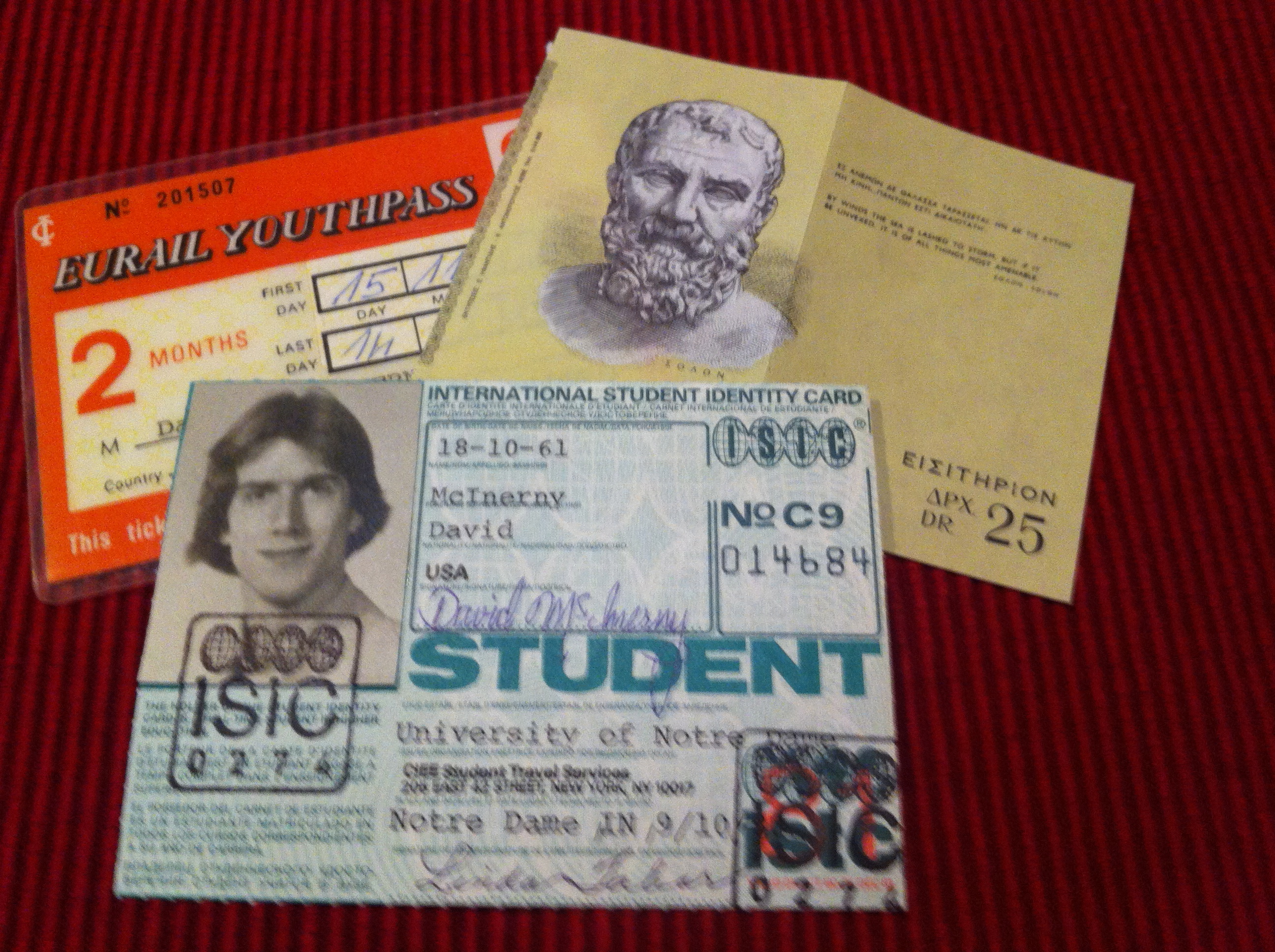
The group with means made their reservations on the fast train to Athens, and procured rooms at a tourist hotel on the beach at Iraklion, which is positioned on the northern coast of the island. The low-budget set mailed home for packages, including tents and sleeping bags, and my letter also included a request for my tape player and a handful of music tapes. We used our pre-paid Eurail passes to reserve the slow train, content to see all of Yugoslavia on the way, every single whistle stop.

After an overnight ferry from Athens to Iraklion (included on the Eurail pass), and a long, hot bus ride to the hotel, we hooked up with our friends that had already spent a day on the beach. We chose a spot a few hundred yards off the hotel property at the edge of the beach, under a single, weathered tree that stretched its trunk in the direction of the sea, and pitched tents under its shade.

There’s not much to say about how we spent our time over the next ten days, and not because my memory fails. It’s just that we meticulously followed a plan to do nothing at all. Mornings were spent sleeping until the heat in the tent became unbearable. We scrambled out of the tents and made our way to the outdoor pool showers at the hotel with slivers of soap. After washing off the previous day’s sand and sweat, we went back the beach to accumulate more. There was swimming, watching flying fish dart their way among us, and there was beach volleyball. There were numerous long walks at the edge of the Mediterranean, always on the lookout for the Scandinavian girls that preferred to swim topless. And there was dinner.

When the smoldering blaze of the sun began to sear the edge of a watery horizon, we pulled on t-shirts for the first time that day and walked the kilometer of so to the closest taverna on the beach. It was a local haunt, since the hotel guests usually ate at the nice restaurant on the hotel property. Our group commanded a little more than half the seating in the place, and when the older couple that owned and ran the tavern realized we would be regulars for awhile, they embraced us as family.

Each dinner began with a walk through the kitchen, where we would point at fish and squid, vegetables and cheeses which would be prepared at our leisure and set upon the tables. We drank beer and ate over the span of hours, learning Greek words from the locals and playing with their children. It was hard to leave every night. Well after midnight, the patriarch would begin to pour small glasses of ouzo, on the house, and if we stood to leave the locals would howl in protest. Eventually, though, the ritual of payment would begin. There was never a menu or a bill, only an offering of drachma on our part, and an insistence on the part of the owners to take less. Ultimately, we would weave our way back down the path, making sure all the girls were accounted for and safe, and tumble into the tents with laughing and deep sighs.

We chose an overnight train from Athens to Innsbruck in order to get some air-conditioned sleep. As we ate cheese in our cabins and prepared to curl up for the night, the conductor moved through the train, checking for tickets and passes. He looked at mine, and explained something in Greek. I shrugged, took my pass back from him and went to sleep. Precisely at midnight, the train stopped. The conductor stepped into our cabin, turned on the light, and made motions that I was to collect my things. He pointed at the date on my Eurail pass, which had expired moments before. Politely, he threw me off the train at a tiny, closed station, and the train moved on without me.

There was a glass-encased train map at the station, and it appeared that I was just north of Dubrovnik, but still well ensconced in communist Yugoslavia. A few hours into my fatigued considerations as to how to get back to Innsbruck, another northbound train arrived. I climbed aboard and hid in the luggage rack until it reached its final destination – Graz, Austria. From there I hitched a ride from a kind gentleman who marveled at my tale, and who drove me directly to my apartment in Innsbruck. I beat the rest of my group home by an hour.

I was nineteen when this adventure occurred, and it is this story that leaped into my memory when my 21-year-old daughter asked to spend this summer as an intern in Dublin. Yes, I let her go … and she returned safely.

The Book Club

Posted in Books with tags on August 24, 2012 by David McInerny

The male halves of our cooking club couples, along with two additions, have started a book club.The six of us now get together monthly on a weekday evening to discuss the latest read chosen by the host for that month. The fact that we all love cooking and eating makes it a bit of a culinary affair as well. The host cooks dinner and offers beer, while the guests bring the wine.  We sip a beer while dinner comes together, and then we switch to wine for the meal and discussion.

It’s not an overly formatted discussion, centered around who liked the book and why, and who didn’t and why. No one is afraid to mix in other subjects, which typically includes national politics, local sports and a critique of the meal. Then the next host is selected, who is also in charge of picking the next book. Prior to the club, I usually read two books at a time, a couple mysteries for every serious novel. Now I’m reading three at a time, which makes me get a little serious about prioritizing which book to pick up when I plop into the chair.

I’m hosting the club for the first time in a few weeks, and I’m looking forward to preparing a menu and digging into a fresh novel. After two assignments based on WWII events, I think I’ll switch the group over to a Victorian novel.


The 3rd Arrondissement

Posted in Fiction, Food, Travel with tags , , , , on August 23, 2012 by David McInerny

We stood in front of the outer door on Rue Charlot, staring at the keypad that triggered the lock.  When we rejoiced at the hefty tailwinds that brought our flight to Paris an hour early, speeding through the suburbs toward the city center in the oversized cab, I had forgotten that we were meeting the representative from the apartment rental website at a set time at the front door, and we were an hour early.  I had a healthy dose of panic.  We were all tired, having had little more than catnaps on the plane, but worse, we were loaded down with luggage that would make it impossible to trek around looking for a chair and something to drink.  Just then the electronic lock buzzed and someone came out of the main door, and we wasted no time pulling our belongings in from the street.  I suggested that I take the boys and look for some sustenance, but my wife knew as well as I did that finding an open café early in the morning on Saturday in Europe can be asking an awful lot.  Nonetheless I stepped back into the Rue Charlot as a woman approached the door and asked if I was Mr. McInerny.

“You are early!  I was coming to prepare for your arrival.  Please come up to the apartment.”  Michelle led us to the third floor, unlocked the door and gave us a tour of our home for the next week.  She had actually lived there for a period of time, she told us, and her pride in the place showed.  It was just big enough for us, and very welcoming, with each room bathed in yellows and browns.  There was a large combination living room and dining room with an adjoining bedroom separated by one of those trendy freestanding, wrought iron folding walls.  The real walls were hardwood, and the entire west end of the room, which faced the street, was a series of, what else, French windows extending from floor to ceiling.  The kitchen was typically European, meaning the size of a walk in closet, but every inch was efficiently occupied with every conceivable cooking appliance, some of which we couldn’t identify.  Opposite was the kitchen was a good-sized bathroom.  On one wall was a clothes washer the size of a coffee can, but Nancy and I knew that was a great advantage that hadn’t been listed on the website.  The main bedroom was at the end of the hallway, and was very large, with a queen bed, writing table, ample closet space, and two large windows.  The kids would sleep in the room off of the living room and the sofa, with the fighting of course being over who would sleep on the sofa.  They could have the TV and stereo, and Nancy and I would take the solitude of the courtyard.

As we moved luggage to the bedrooms, Michelle opened a bag she had brought and laid out sweet rolls and orange juice in the dining room table for the kids, and opened a bag of coffee and soon had its aroma wafting through the apartment.  What a great surprise!  She showed us a listing of phone numbers to reach her, as well as the keypad code and Metro maps.  She handed us the apartment key, wished us a great week as she closed the door, leaving Nancy and I beaming at each other to the sounds of the kids munching and slurping their breakfast.

Anyone who flies across the Atlantic is familiar with the advice that states that when you arrive, usually in the early morning local time (but the middle of the night for your body), you should continue to go through the new day without sleeping in order to acclimate your body to the new time zone as quickly as possible.  Guidebooks and well-meaning neighbors insist on this principle, particularly if the trip is only for a few days.  I certainly was forced to adhere to this maxim when traveling to Europe for work, not through any conviction on my part, but because I was typically whisked from the airport to a manufacturing plant for the day and continuing, if my host was especially cruel, with a nice, long dinner after the workday.  (I remember once finally climbing into bed in Eindhoven, the Netherlands, after being awake for over thirty-five hours, wondering how I had survived the ordeal.)  So after doing a bit of unpacking while Alex, the youngest, flipped through TV stations to find only the BBC news was in English, Nancy and I discussed the positive merits of trying to stay up for the balance of the day.  Duly noted, within the hour we were all snoozing peacefully in our beds, oblivious to the muted sounds of the metropolis outside.

Later in the afternoon we toddled, sleepy and somewhat dazed, out of the door to explore the Marais district.  On the steps was a teddy bear tied to the stair railing.  The kids had noticed him when we were bring our bags in and stopped to wonder at his presence.  He was worn, as if he had spent a few years being hugged by some Parisian tot, but he had an ominous look to him.  Sporting a bandana and an eye patch, he struck me as pirate-like, but the kids took to calling him Voodoo Teddy, and they greeted him as an old friend each time we came and went.  They thought he was cute, but it made Nancy and I wonder what kind of neighbors we had.

It was impossible for me to imagine Paris without assuming scenes of old women with flower carts, cobblestone streets and gothic church spires thrusting into the sky, and I was pleasantly surprised that those thoughts were not overly idyllic.  The Marais district, which is within the 3rd arrondisement of Paris, is on the north side of the Seine River, directly above the Cathedral of Notre Dame.  It is residential, but still within a short walk of the main sights along the river.  As we wandered toward the river for the treble purposes of waking up, finding a place to eat, and checking out the neighborhood, I noticed that the people we encountered on the street were … French.  The stores and shops were open, and I felt we had succeeded in finding an apartment that was where the locals were, because no self-respecting tourist ever wants to spend too much time feeling or acting like one.  Unlike the gold medal tourist sights where I knew we would hear a multitude of languages (only French from the vendors and salespeople), we had our own little French hidey-hole to come back to each day where we could be one of the people.  The narrow streets harbored antique shops, tiny shoe shops and art galleries, which I assumed made ours a somewhat upscale hidey-hole.

We also gleefully noticed that we would never be at a loss to find a place to eat near home.  Innumerable cafés, restaurants and brasseries lined most streets, and I wondered if the French ever eat at home.  I remember reading that there were ways of distinguishing between a café and its cousin the brasserie, but at the moment I didn’t care about semantics – everything looked inviting.  The cafés would seize every inch of sidewalk space for outside tables surrounded by flower boxes to provide a bit of privacy and a profusion of atmosphere.  Waiters, mostly male and looking very serious and professional, if not a bit intimidating, moved briskly in and out of the cafés with trays of sandwiches, seafood tidbits and glasses of chilled white wine.  There was general agreement among my troupe that sightseeing was to be immediately suspended in order to explore the gastronomic delights of Paris.

It must have been peak café time for Saturday, because every establishment was hopping and we nearly got to the river before we found a nice little square on the Rue Rivoli very near the Hotel D’Ville.  We found a place that had all the things parents traveling with their children need when having a bite.  The square allowed the boys to wander from the table and explore without the danger of traffic, and where we could keep an eye on them.  Also, the café’s menu was conveniently posted outside so that we could make sure everyone would be happy with a selection before we sat down (this we found was commonplace and saved us several times from getting settled at a table only to find that there was nothing to appeal to our youngest).  Finally, there was a restroom for the patrons, still not as common as one would expect in most parts of Europe, and a constant source of latent concern for traveling parents with youngsters.

I was looking forward to my first chance to spread my linguistic wings as we sat down and the menu was placed in front of me.  “Merci,” I murmured casually, and noticed to my chagrin the menu was in both English and French.  Undeterred, however, when our young waiter returned I ordered our meals in French, and was pleased that he responded in French, throwing in his own broken English when he guessed, correctly, that I was struggling.   In most cases, we were to find that the French were ready to speak English to us, but when we initiated with French, however choppy, they were happy to accommodate us with their native language.  So much unlike the legendary French waiters of yore we all hear about back home.  Regardless, I figured that I had taken the time to buy French discs and spent several weeks in the car working with them, and I was going to see how far I could take us in situations before I had to skulk back to English.  This attitude made the kids fearless also, and within days were responding and greeting locals in short, polysyllabic phrases.

The kids enjoyed wafer thin pizza and small glasses of cola while my wife and I snacked on avocado slices with shrimps and cold beer.  As we languished over our drinks, the boys played among the trees that were in a sea of cobblestone in the middle of the large square.  It was cloudy as we ate, but as we walked back to the apartment along a different path, with my daughter and wife pausing frequently to get a handle on the skirt and shoe fashions, the setting sun broke out of the clouds and provided grand illumination of the reds and ochres of the tapestries in the windows of the Marais antique shops.

Healthy Chips

Posted in Food with tags , on August 22, 2012 by David McInerny

It doesn’t have to be potatoes. Heat two inches of a light tasting oil, like canola, until it starts to slightly smoke. Rinse a cup of spinach leaves, and/or a half cup of artichoke leaves. Make sure the leaves are dry, or the spattering will be frightening. Drop the leaves slowly into the oil, slowly, with a metal spoon, for 10 seconds with spinach, 30 seconds with the artichoke leaves. Place on paper towels to drain, and then sprinkle with pepper and parmesan cheese. Crispy loveliness.