John Updike – The Henry Bech Series
As prolific as Anthony Trollope, and as erudite as Hilaire Belloc, John Updike was a shining light in American writing, following in the epic literary footsteps of Hawthorne, Cooper, Melville, Twain and Steinbeck. He won every major book award available in the U.S., and the fact that he never won the Nobel prize for literature has nothing to do with not earning it, and everything to do with the silly political correctness of that erstwhile august institution.
His oeuvre includes twenty-four novels, seventeen volumes of short stories, ten volumes of the most eclectic collections of essays and criticism I’ve ever encountered, five children’s books, a play, his memoirs, and eight volumes of poetry, aptly culminating with the title, Endpoint. His fiction has itself spawned scores of scholarly works, and has made it to both the small and big screens.
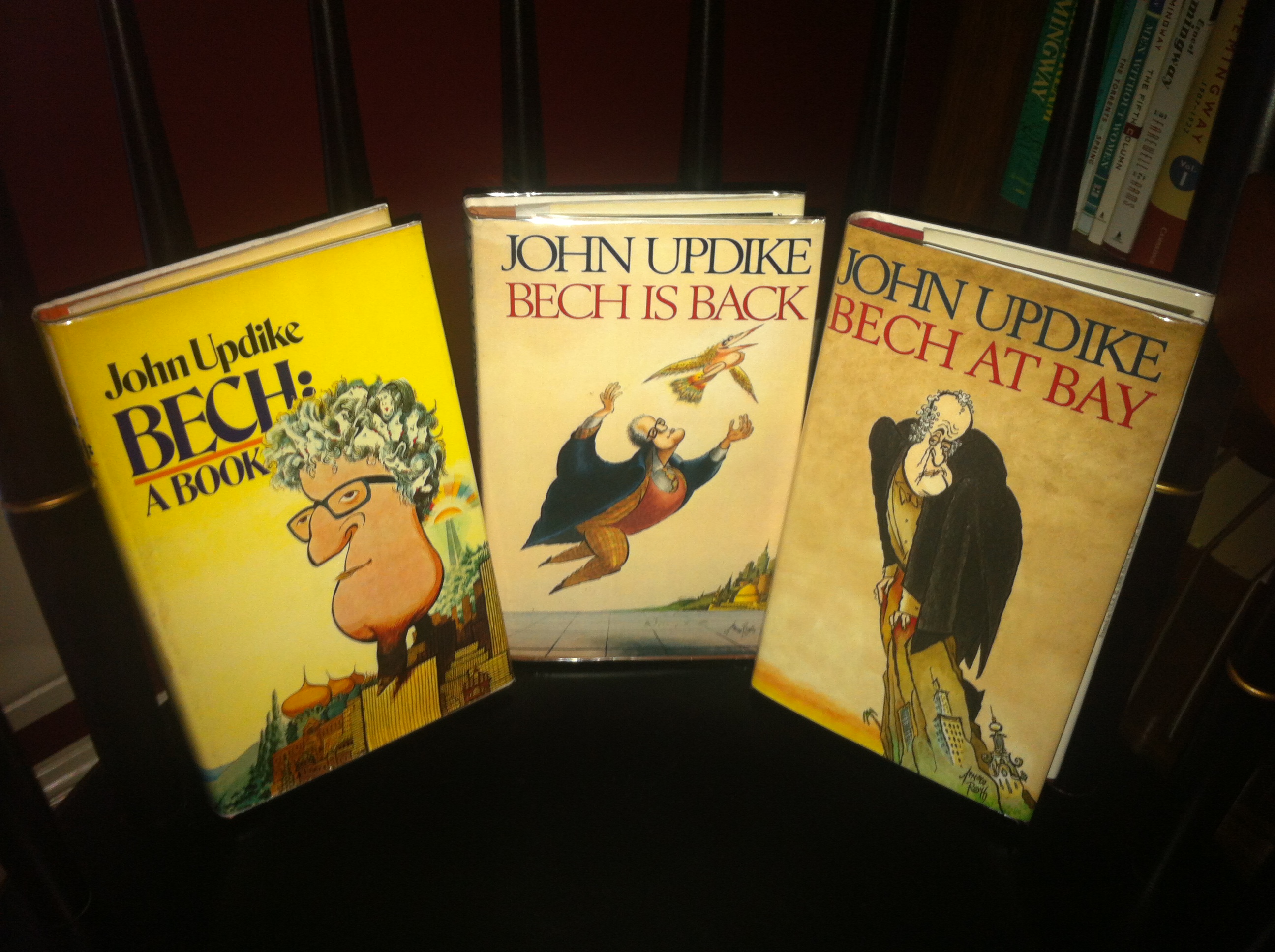
Angstrom Rabbit was the justified critical apex of Updike’s Rabbit series, but I’m much more partial to another serial creation of Updike’s – Henry Bech. The trilogy of Bech: A Book (1970), Bech is Back (1982), and Bech at Bay (1998) are an Updike poking fun at the world of writers and literary acclaim. It is some of his most amusing writing, at time approaching P.G. Wodehouse in it’s plausible ridiculousness. Henry Bech is a fiction writer on the downside of his writing career; in fact, he’s still living off the glories established with Kerourac-esque efforts written in his salad years. Throughout the books, Bech increasingly has to come to grips with the fact that, while he still pulls in a serious income on the speaking circuit, there is a widening body of critics that are deciding his best efforts have become dated. It’s not that Bech has lost his skills to write at this later point in his life; he just keeps getting distracted by an ever-aging camp of female groupies who, after a few months with him, decide he’s an old hat as well. Bech’s work is forgotten in America, but adored by fans in former Soviet bloc countries, ignored by his generation, but revered by college students. It’s an angst-ridden yin & yang for our protagonist, and it keeps him up at night (though rarely alone).
I’m reading the last book of the series, and I find it the best of the three books. Bech is forced to confront his critics in the United States and, worse, to converse with his peers who have continued to write successfully into their early dotage. The results are both hilarious and sometimes shocking, shock being an atypical tool of Updike. I won’t spoil it for you.
I encountered John Updike’s work when I was required to read The Centaur in Liz Christman’s creative writing class as a freshman at the University of Notre Dame. I appreciated his skill, but didn’t become hooked until I picked up The Witches of Eastwick (later a movie with Jack Nicholson and Cher), and wondered from where that kind of imagination came. I grabbed his books as soon as they were published, and I’ve been collecting his first editions for twenty-five years. I only lack two at this point, and I now search for them haphazardly, not wanting the project to end (yes, I know I could find them for a fortune tonight online, but I prefer to feel the rush of encountering them in a musty bookstore when I expect to find nothing at all). One of the prizes of my collection is a counterfeit copy of Bech: A Book, produced in China, even including a copyright page in Cantonese. Just the sort of adulation Henry Bech enjoyed outside of the U.S.
There are two chapters remaining to read in my book. I read a few pages at a time, savoring them, knowing there will be no more. At some point, too, there will be no more reason to enter a secluded specialty book shop in New Orleans who’s owner is an Updike fan, who entertained Updike in his store and, each year when I enter his shop says, “Here is the Updike man.” What a nice compliment. I love no American author more than John Updike … after Ralph McInerny, of course.
 berowne.com
Leave a comment