Brian Eno – Discreet Music
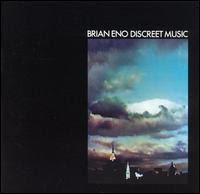 When Brian Eno left Roxy Music to follow its own historic path, he created two solo albums which were of similar energy and purely English eccentricity, Here Come the Warm Jets, and Taking Tiger Mountain (by Strategy). In 1975, however, Eno followed a muse he had been contemplating for over a decade, that of creating “ambient” music, lengthy pieces that were not to be listened to actively. The simile he used in the liner notes of Discreet Music was that of hearing it rain outside, but not listening to it. Discreet Music is his first of many successful attempts to make pleasant, meandering music meant to be played at barely audible levels.
Eno made use of fairly new recording technology, that of a synthesizer and delay machine, and embarked on a unique method for the first side of the album, thirty minutes called “Discreet Music.” After programming melodic bits into the synthesizer, he allowed them to loop and echo into a piece that is hypnotic, ebbing and flowing at the edge of the threshold of hearing when played at the suggested volume level.
Side two is equally fascinating. Eno gathers a classical ensemble and instructs them to begin playing several bars of Pachelbel’s Canon in D Major, after which they are to improvise on the piece however they wish. The results are loose and pleasant, a mix of the classical and modern not since attempted, with the possible exception of Philip Glass who, ironically, scored an Eno effort with David Bowie into classical format (Low).
Brian Eno is not only aware he is putting music in motion without an active hand afterward; it is actually his aim to be a listener of the results as well. Ambient music is a theme Eno returns to throughout his recording career, and it is my go-to music for trans-Pacific flights, nights in noisy hotel rooms, and occasions when I need to lessen a nagging case of Weltschmerz.
 berowne.com
Leave a comment