Archive for the Books Category

Saucier – Beginning at the Beginning

Posted in Books, Food with tags , , , , , , , on December 27, 2014 by David McInerny

IMG_2603I think I can trace back my desire to get serious about cooking to a single evening. My mom was visiting us in Chicago with her best friend. Her friend was a refined Londoner I had known my whole life, and whose Italian home I had visited any number of times in Perugia, so it was a pleasure to have them stay while they explored the city for a few days. They arrived too exhausted to endure a restaurant, but my mom asked if there was anything easy for them to snack on. Thinking of all the meals these two women had made for me over the years, I felt it was imperative that I whip up something nice for them. My wife wasn’t home yet, so being on my own, I pulled out a paperback copy of the Fanny Farmer Cookbook I used when I occasionally took over the responsibility for making dinner.

I wanted something quick to make, so I chose a simple recipe that has now long been my “go-to” meal-in-ten-minutes specialty: scrambled eggs topped with asparagus tips sautéed in Parmesan butter. They loved it, and Sally, the English expatriate, looked at me and asked me how I had learned to cook like that. That galvanized my desire to learn more about cooking and, admittedly, maybe garner more fabulous praise like Sally’s.

Soon after I arranged a week off from work to take cooking classes from a school in the western Chicago suburbs run by two retired one-star Michelin French chefs. At their recommendation I took the course on making classic French sauces. In retrospect, I should have been paid by these talented but cunning cretins to take these classes. What they didn’t say was they ran a small, eight table bistro in the front of the kitchen, and my other classmate and I were responsible for all the prep to serve dinner for the single seating at 6pm each evening. We arrived a 7am each morning, and before there was any mention of possibly making, let’s say, some French sauces, we sharpened knives, cleaned chickens and rabbits, and chopped mirepoix until our hands shook. Around noon we lunched on remainders of the previous day’s meal, and finally started roasting veal neck bones for stock.

We made oceans of stock, boatloads of demi-glace, and mounds of glace. From there the sauces finally flowed, and each evening around dark, I’d arrive home exhausted but equipped with a quart of the sauce I’d spent the day making over and over until the chefs declared it just right. The neighbors would be waiting in the cul de sac with bread in hand, waiting to dip right in before I barely got out of the car. The desire to please people with food has never left me.

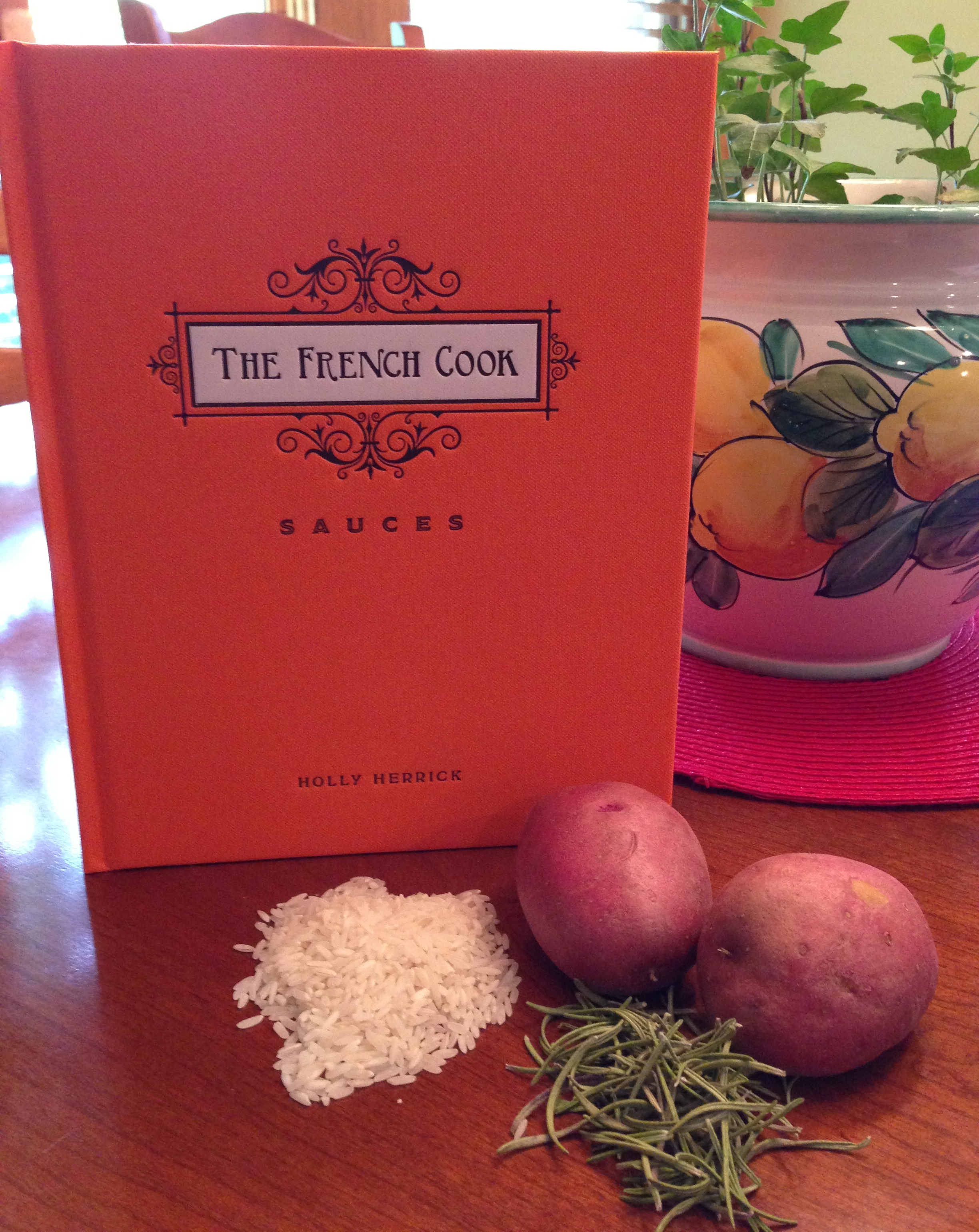
I still use that old copy of Fanny Farmer because it remains the vital guide to overall American cuisine, but I’ve kept my saucier skills sharp with a copy of the Cordon Bleu Cookbook given to me for my birthday that year from one of those grateful neighbors. This year though, I’ve fallen in love with a new sauce book by Holly Herrick. Her Sauces cookbook in The French Cook series (Gibbs Smith Publishing, 2013), is a tidy yet complete volume of all the essentials. Cordon Bleu trained, she presents recipes and techniques that are classic, and the photos (and what good is a cookbook without photos?) are plentiful, large and in full color. I strongly recommend Sauces  for anyone looking to cook well from the start, or to raise their skills a classic notch. As I often tell people who don’t even like to spend time in the kitchen, if you can make a quick and simple Béchamel, you’ve just turned a boiled box of pasta into a French culinary delight. Bon appetit!

 

Richard III – DNA Match

Posted in Books, Travel with tags , , , , , , on December 3, 2014 by David McInerny

_79448768_79429127You can’t make this stuff up. Two years ago a skeleton was discovered under a parking lot in Leicester, England. Historians had posited that King Richard III had been buried there in what was Greyfriars Abbey. They dug, and they found remains. Today the BBC reports that test results of DNA from the skeleton matches DNA from known descendants of Richard with 99.99% accuracy.

Briefly, Richard III was the last English king to die in battle, in this case the Battle of Bosworth in 1485, slain by the army of who would become king Henry VII. This marked the end of the Plantagenet royal line and the beginning of the Tudors. (See my December 17, 2012 blog for a review of Shakespeare’s Richard III.)

Remarkably, the DNA evidence also reveals something else. It appears that somewhere along the line the female chromosomes picked up an anomaly that can only be explained by … infidelity. Unfortunately, it can’t be determined whether the infidelity occurred before or after Richard or, even stranger, whether the indiscretion is to be found on the Plantagenet or Tudor side, since both families sprung from the same ancestor, Edward III.

Was either royal line legitimate? Should the current royal family be under scrutiny? Who knows, but look for juicy, “based on a true story” historical dramas springing from British PBS over the next few years. Downton Abbey, move over, historical reality TV is on the way!

images


Bird – The Life and Music of Charlie Parker

Posted in Books with tags , , , , , , , , , on November 9, 2014 by David McInerny

IMG_4362Chuck Haddix, music archivist for the University of Missouri at Kansas City, has written a fresh and well-researched biography of local jazz legend, Charlie “Bird” Parker. It’s a short but thorough read about the Kansas City, KS native that transformed the alto saxophone into a juggernaut for musical change. The narrative covers Parker’s formative years in Mayor Pendergast’s rough and raucous Kansas City, MO during the Depression and Prohibition.


Here we learn of the young musician’s fascination for the jazz scene on 18th and Vine streets, his tenacity in breaking into the local scene, and how he honed his skills on the sax through long nights of playing with the regional greats in jazz. It was also on 18th and Vine where Bird discovered drugs and alcohol, habits which would dog him his entire career and end his life in its prime.

Charlie was tutored under the guidance of the Jay McShann Orchestra, where he learned to play swing standards and blues-based KC jazz. Quickly, he was wowing audiences with his quick and crisp 32nd notes, and capturing the attention of future national great Count Basie. But it was a trumpet player, Dizzy Gillespie, that was magnetized by Parker’s style, and together they launched what was known at the time as the “moderns,” who eventually developed the next evolution in jazz style, Be-Bop.

The influence Parker had on jazz within his lifetime and beyond is profound. His stardom took him around the continent and ultimately to New York, where his star soared. His protege’s were numerous, but none more faithful than another young trumpet player by the name of Miles Davis. Davis continued to blaze the trail forged by Bird until he in turn introduced the next phase in jazz styles – Cool Jazz.

This is an essential book for the music lover about a Kansas City icon, written by a local author who interviewed extensively those who played and lived with Charlie Parker, and uncovered history about him that is in print for the first time. Chuck Haddix was kind enough to personalize my copy of his book with the following greeting: “To David, I hope you enjoy this study in ornithology. Bird lives! Chuck Haddix, August 16, 2014.” I enjoyed the study tremendously.

IMG_4353

Grant’s Vicksburg Legacy

Posted in Books, Travel with tags , , , on June 4, 2014 by David McInerny

IMG_3883When Shelby Foote was asked by his publisher to write a short history of the Civil War, he responded with a 2,900 page, 1 million word epic which took him twenty years to complete. You may remember Foote as the gray-bearded commentator of the Confederacy in Ken’s Burn’s TV documentary. He was a native Mississippian author, and a friend of the equally erudite author Walker Percy from the same state.

Having recently toured the Vicksburg battlefield, and remembering Foote was from Mississippi, I was interested to read how the author treated the Union siege victory within his home state in 1863. I’ve just finished reading his 350 page chronicle of the conflict from his 3 volume opus. Understandably, Shelby is not overly kind to Grant, fueling his reputation as being cruel to friends and foe, as well as a drunkard. He takes pains to describe the situation in which the Confederate general Pemberton calls for a truce so that Grant’s army can clear the Union dead from outside the Vicksburg embattlements, such was the stench resulting from the oppressive June heat. Cruelty on Grant’s part, or a gruesome yet effective psychological stratagem?

Right before Vicksburg falls, and the Union regains control of the Mississippi River, Foote detours into the only chronicled episode describing Grant’s alleged drinking, a two-day bender in which Grant is saved from embarrassment in front of his troops by a reporter, the same reporter who tells the story. I do not begrudge Shelby Foote his bias, which is shown in many more occasions of his description of the conflict, but it does indeed show how the love of time and place can affect the view of the historian. Further, it must be said, I still consider Foote’s work to be the defining word on the history of the Civil War, with apologies to McPherson and Catton.

The fact is, Grant’s victory at Vicksburg reflected Napoleonic genius in its planning and execution, as declared by General Sherman, whose reputation was made there as well, and by Lincoln himself. The latter awarded Grant the rank of Major General after battle. When detractors approached Lincoln with stories of Grant’s cruelty and love of whisky, he always responded in the same way. “I can’t spare him. He fights.”

IMG_2564

Goethe and Faust

Posted in Books, Music, Travel with tags , , , , , , , on May 28, 2014 by David McInerny

IMG_3226On a recent business trip to Frankfurt, I stumbled across the Goethe Haus und Museum, which brought back sweaty memories of reading his magnum opus in German at Notre Dame. Faust is the original “deal with the devil” tale, with God and Mephistopheles making a bargain for Faust’s soul. Faust, a devout but intellectually striving man, is tempted by Mephistopheles (Satan), and finds himself caught up in sensual pursuits that culminate in sex and murder. Despite his shortcomings, Faust never gives up on his desire to receive God’s grace, and in the end is saved. Act V: “He who strives on and lives to strive/ Can earn redemption still.”

More complex than the American version of the devil’s bargain – bluesman Robert Johnson’s alleged deal at the “crossroads” with Satan in order to play the guitar with extraordinary skill – Faust is the apex of German literature in its universal appeal to the frailty of the human condition. It was, and is, the worthy successor to Dante’s Inferno and, while you may never read either, a visit to Goethe’s home is a worthwhile venture. If you find yourself there, make your way to Florence to see Dante’s home as well!

Additional Music Listening:

Robert Johnson: Cross Road Blues (1936)

Cream: Crossroads (1968)IMG_3224

IMG_3225

Frankfurt Altstadt

Posted in Books, Food, Travel with tags , , , , on November 8, 2013 by David McInerny

IMG_3219There is a comfort in visiting German cities in that there is always the reliable Altstadt, or Old City, predictably waiting in the epicenter of town. Simply look for the tallest church spire in the skyline and walk toward it. Soon cars will be diverted away, and the streets will turn cobbled. Then a main square opens up revealing the church, ornate 18th century structures, and the formidable Rathaus, or Town Hall. Frankfurt is no exception. 

It’s easy to understand why the welcoming feel of the typical German Altstadt has been the inspiration of places as diverse as Epcot and downtown Vail. Impeccably clean and tidy, Frankfurt’s Altstadt is as inviting as any German city, but with more of a sense of coziness than Munich’s or Cologne’s. While, as anywhere, you’ll pay more for a meal for the privilege of location and a view, once situated the tourist is welcomed and his rusty German tolerated, if with mild amusement. Outdoor cafes abound, as do the inimitable German Gasthaus, guesthouse, which is the equivalent of the French bistro. The culinary anchor of Frankfurt’s square is the Schwartzer Stern, or Black Star restaurant, and its prices reflect its reputation. I prefer a seat outside at a cafe, where I can watch an accordionist and clarinetist play soft jazz to the passersby for coins tossed on a blanket.

The Frankfurt Altstadt has the additional benefit of boasting the birthplace of Germany’s literary son, Goethe. Faust, his great tragic play, is still a perennial favorite among Germans and remains on the “great books” list of major Universities. It was a joy to stumble across the house and have a surprise chance to see the excellent museum inside.

Frankfurt is the European hub for many U.S. airlines so, if on the way to Munich, Paris, or Rome you have a layover in Frankfurt lasting more than two hours, the Altstadt here is well worth the ten minute cab ride from the airport.

IMG_3213

IMG_3214 IMG_3215 IMG_3216

Death in the Afternoon – Ernest Hemingway

Posted in Books, Family, Travel with tags , , , , on October 29, 2013 by David McInerny

IMG_2853Without using the phrase, Hemingway recognized that by the 1920’s political correctness had already pushed the golden age of bullfighting into the past, but there was still honor in the spectacle, and Papa cherished all things honorable. Honorable because bulls were still bred for fighting characteristics, reared with as little familiarity to man as possible so as to keep the beasts wild and unpredictable. Honorable because the matador stepped into the ring without armor, knowing that goring was common, and death was certain – death of the matador if the bull was not managed meticulously.

Death in the Afternoon is more than a treatise on bullfighting, as the book is most often described. Surely, Hemingway details the cultural impact of bullfighting in Spain, the great fighters of the time, and the techniques of breeding great bulls, but the novel’s brilliance is his discussion of human nature through the prism of the fight.

Hemingway dissects those who attend the bullfight; the aficionados, the curious, as well as those predisposed to dislike the event. Even more fascinating, he discusses the matadors and what motivates a man to enter, and make a career, in the ring. For some it’s honor, others family tradition, and some a hope for a large fee. As an expert, Papa can tell the men from the frauds by their footwork, the movement of the muleta, and a willingness to allow the bull’s horns to pass in dangerous proximity to the matador’s belly.

Hemingway traveled from Pamplona to Valencia and Madrid watching the fights. In Valencia, he loved his dinners at La Pepica, a restaurant located on the beach at the edge of the Mediterranean. At the time he was immortalizing his love of bullfighting in his first novel, The Sun Also Rises, and his aura can still be felt in La Pepica as one swills wine and tucks into a bowl of seafood soup. Death in the Afternoon is a somewhat forgotten Hemingway classic, and I recommend reading it on the beach in Valencia, knowing dinner awaits when the sun goes down, at La Pepica.

100_3310

Beyond Bourbon

Posted in Books, Music, Travel with tags , , , , , , , on July 27, 2013 by David McInerny

20130727-155043.jpg

20130727-160132.jpg

20130727-160220.jpg

20130727-160244.jpg

20130727-160306.jpg

20130727-160337.jpg

20130727-160406.jpg

Gratitude from berowne.com

Posted in Books with tags , on June 30, 2013 by David McInerny

20130701-064230.jpg

On the occasion of berowne.com having achieved over 10,000 views, I would like to thank my readers and followers from over 70 countries for their loyalty and indulgence. I truly appreciate the readership!

Summer Reading: 2013

Posted in Books with tags , , , , , , , , , , , , , , , , , , , , , , on February 23, 2013 by David McInerny

IMG_2350I know many of us are still looking at snow outside our windows, but it’s not too early to think about collecting a stack of books for a vacation on the beach, nights in a hotel, or just a quiet, warm evening on the back deck. Here are a few suggestions for 2013 summertime reading that have fascinated me:

1. Degas In New Orleans – Christopher Benfey (1997)

Edgar Degas, an important early Impressionist painter, spent time in New Orleans with American cousins during the late Reconstruction period. Benfey writes a thoroughly interesting documentary of Degas’ time there with contemporary local luminaries, while the painter captures this period in American Louisiana history with some of his most famous work.

2. Battleborn – Claire Vaye Watkins (2012)

With unusual skill for such a young talent, Watkins conjures a host of restless souls in this series of short stories based in the early boom time of post-wild west Nevada. Her style is reminiscent of John Updike’s short story linguistic magic.

3. The Sun Also Rises – Ernest Hemingway (1926)

Parisian nightlife, Spanish bullfights, afternoon fly-fishing and romantic, expatriate angst – Papa hit his creative stride with this quasi-autobiographical novel about the search for meaning within post WWI’s “lost generation.”

4. Stars In Their Courses – Shelby Foote (1997)

Adapted from Foote’s epic three-volume history of the Civil War, this is the definitive description of the three day Battle of Gettysburg. Shelby Foote humanizes the event like no other, and this book makes timely reading for the 150th anniversary of the battle on July 1,2,3 of this year.

5. Neither Here Nor There – Bill Bryson (1992)

Recreating his collegiate European travels two decades later, Bryson weaves hilarious tales that have the reader laughing from Amsterdam to Rome. If you can’t afford a European vacation this summer, this book is the next best thing.

6. Too Many Cooks – Rex Stout (1938)

The detective Nero Wolfe, Stout’s corpulent creation, along with his witty assistant, Archie Goodwin, are at their finest uncovering a murderer amidst an august gathering of gourmands. Fair warning – the Nero Wolfe mysteries are a classic series that will hook you for years.

7. The Marseille Caper – Peter Mayle (2012)

Peter Mayle has entranced readers with his autobiographical books on life as an Englishman in Provence, France. His newest book is another of his comic mysteries en par with the humor of P.G. Wodehouse.

8. An Eye For An Eye – Anthony Trollope (1879)

Downton Abbey fans, Trollope was the original master of serialized British drama and suspense. Long before TV, magazine readers waited for the latest installment of happenings among the aristocracy, and the regular folk who served them. This book about tragic love is set in Ireland, and reaches its climax on the cliffs of Moher.