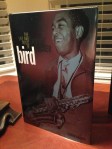
 Chuck Haddix, music archivist for the University of Missouri at Kansas City, has written a fresh and well-researched biography of local jazz legend, Charlie “Bird” Parker. It’s a short but thorough read about the Kansas City, KS native that transformed the alto saxophone into a juggernaut for musical change. The narrative covers Parker’s formative years in Mayor Pendergast’s rough and raucous Kansas City, MO during the Depression and Prohibition.
Here we learn of the young musician’s fascination for the jazz scene on 18th and Vine streets, his tenacity in breaking into the local scene, and how he honed his skills on the sax through long nights of playing with the regional greats in jazz. It was also on 18th and Vine where Bird discovered drugs and alcohol, habits which would dog him his entire career and end his life in its prime.
Charlie was tutored under the guidance of the Jay McShann Orchestra, where he learned to play swing standards and blues-based KC jazz. Quickly, he was wowing audiences with his quick and crisp 32nd notes, and capturing the attention of future national great Count Basie. But it was a trumpet player, Dizzy Gillespie, that was magnetized by Parker’s style, and together they launched what was known at the time as the “moderns,” who eventually developed the next evolution in jazz style, Be-Bop.
The influence Parker had on jazz within his lifetime and beyond is profound. His stardom took him around the continent and ultimately to New York, where his star soared. His protege’s were numerous, but none more faithful than another young trumpet player by the name of Miles Davis. Davis continued to blaze the trail forged by Bird until he in turn introduced the next phase in jazz styles – Cool Jazz.
This is an essential book for the music lover about a Kansas City icon, written by a local author who interviewed extensively those who played and lived with Charlie Parker, and uncovered history about him that is in print for the first time. Chuck Haddix was kind enough to personalize my copy of his book with the following greeting: “To David, I hope you enjoy this study in ornithology. Bird lives! Chuck Haddix, August 16, 2014.” I enjoyed the study tremendously.

 berowne.com