Archive for Grateful Dead

Never Alone in the Grateful Dead Community

Posted in Music with tags , , , on June 15, 2014 by David McInerny

IMG_3911Driving home from work on Friday, I was listening to the local blues station. Before a break the DJ announced that a few tickets remained for Saturday’s Bob Weir concert in KC. How I missed that is a mystery, but I walked in the house and prepared to buy tickets. The Missus, still jet-lagging from a European trip, declined to go, so I bought one ticket. All that remained were nosebleeds, but I considered myself lucky.

I went to my very first Dead show with David and Darcy, and somehow we accidentally met at the front door of the theater, exchanging hugs over our good fortune to have an impromptu evening together with good music. They had driven into town from Nebraska and were staying at a hotel around the corner. Inside we immediately ran into Stacey, a local friend who was with a group of friends. Surrounded by Grateful love, we settled in for the first set.

Bob Weir was rhythm guitarist, songwriter and co-vocalist for the Grateful Dead. His current band Rat Dog takes the Dead canon into jazzier, more sensual spaces, and Bird Song, Dark Star, and Eyes of the World were highlights of the evening. Our group twirled, sang, sent pics to Sugar Magnolia, and caught up on old times. And we made a plan to meet at the next Widespread Panic show! When I got home, the Missus apologized that I had to go to the show alone. She was shocked at how alone I wasn’t!

IMG_3908

Furthur Down the Road

Posted in Music, Travel with tags , , , , , , , , on October 7, 2013 by David McInerny

IMG_3050The Greek Theater in Los Angeles is an intimate locale for Bob Weir, Phil Lesh and Furthur to end this year’s touring.  Six thousand seats set in the edge of the northern foothills, surrounded by gnarly pines, brings Neal Diamond’s callout to the “tree people” on his 1972 live album recorded here, “Hot August Night,” immediately to mind. The mood is remarkably calm for a final show, due I suspect to the high prices scalpers were demanding of Deadheads in the parking lot. As a result, the quotient of Jaguar-riding aficionados is high, but the exuberance is no less palpable. Bill Walton is in the row ahead of me, chatting casually and posing for pictures as the lights go down.

It’s an evening of treats, and clearly Phil and keyboardist Jeff Chimenti have been given the nod to lead the proceedings. Lesh’s vocals take center stage on gems of his like Pride of Cucamonga and Unbroken Chain, but the biggest fun comes from Chimenti who drives the extended jams in these songs into a jazzy realm that inspires Weir and lead guitarist John Kadlecik into unique and pulsating chord patterns.

IMG_3036

Intermission brings the good fortune of of a separated couple looking for a ticket swap that lands me in the sixth row, allowing me to feel the front-on assault of a frolicking St. Stephen. The upper crust Deadheads performed admirably, staying on their feet throughout the show, and singing loudly with the band. There were no tree people on this evening, but the parking lots remained full of the unfortunate ticketless who could nonetheless still hear the band and twirled anyway.  This not-so-new iteration of remaining members of the Grateful Dead has gelled fantastically, and have become a combo with their own identity. As the saying goes, Jerry would love this band.

IMG_3048

The Music Never Stopped

Posted in Music with tags , , , , , , , , on September 4, 2012 by David McInerny

I had a few Grateful Dead albums that I enjoyed in college, particularly Blues for Allah, Terrapin Station, and Go to Heaven. I wasn’t by any means a Deadhead, but that changed on August 9, 1995. I was driving home from work in Chicago, listening to WXRT radio, and it was announced that Jerry Garcia had passed away from a heart attack. I listened to the lovely tribute and music throughout the evening on WXRT, and determined to listen more deeply to the music of the Grateful Dead. Seventeen years later, I’m still doing that.

I was very fortunate in that by the late nineties, once I had devoured their studio work, it was easy to access their vast, informal catalogue of live concerts. Unlike any other band at that time, a very few more know, the Dead never played the same show twice, constantly mixing set lists, styles, lengths of songs, and also adding in a healthy dose of surprise cover songs. This is why the band garnered a following that joined them from show to unique show, and began trading tapes of shows that the band not only allowed, but also created space for next to the soundboard at each concert. The band’s sound engineers recorded each concert de rigueur, so that they and the band could listen and improve the experience for the listeners. The tapes were retained. Luckily for me, by the time of Jerry’s death, the Dead had a cutting edge website that was opening up these live archives and releasing them digitally. The discs came with a caveat emptor (because the tapes were never made for retail release), but that was rarely necessary, since Deadheads were now listening to a level of quality long lost in the copying of tapes over several decades.

I’ve snapped up these releases as soon as they were offered. Famous concert runs at Winterland and the Fillmore East, rare early concerts at Lake Tahoe, epic Wall of Sound shows from the Spectrum – each show has its own personality, energy, and artistry. My username on Dead.net is Late Bloomer, which I chose because I never saw Jerry play. Nonetheless, various incarnations of the remaining members still tour continuously, and still write music. I get to at least two shows a year, and occasionally take a week off work to follow the band for a handful of shows across the country.

The latest archive release is a limited edition set of six complete shows from 1990, packaged in a beautiful box with period memorabilia and a handbook of essays and memoirs from that concert run. My set arrived in the mail today, so please excuse me; I have eighteen discs that are waiting to be loaded onto my iPod.

Duane Allman – Lost Master

Posted in Music with tags , , , , , , , , , , , , on September 2, 2012 by David McInerny

Duane Allman doesn’t have even the small body of “frontman” work that Jimi Hendrix has to shine a light on his virtuousity, but you know his guitar work well from the endless session work he did with sixties hit-makers (Boz Scaggs, Aretha Franklin, Clarence Carter, and Wilson Pickett, for starters), as well as later with Derek and the Dominos and, of course, the Allman Brothers Band. He died in 1971, before he had a chance to develop his signature sound, but the straight-up and slide guitar work that remains with us is a pinnacle of soulful, bluesy southern rock.

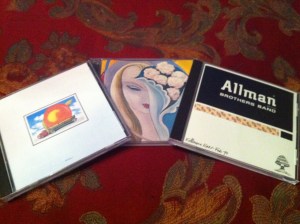
Prior to the Allman Brothers formation in 1969, Duane and his iconic brother Gregg recorded a collection of tracks in 1968 (released in 1972 as Duane and Gregg Allman). In these early sessions, Duane displays the polished playing honed from years in the studio backing other artists, but the brotherly synergy took his playing in a direction uniquely his own. The album begins with the anti-war folk classic, “Morning Dew,” but mimics Jeff Beck’s more pyrotechnic arrangement from Truth, released the same year. Rod Stewart sang on Beck’s version, but the Allman’s raise the ante, with Duane’s guitar and Gregg’s keyboards and voice driving much more soul into the song, which is more deserving of the subject matter of the lyrics. An early “Melissa” is a gem, as is “Nobody Knows When You’re Down And Out,” which was re-recorded on Eric Clapton’s Derek and the Dominos.

On February 13 and 14, 1970, the Allman Brothers Band headlined with the Grateful Dead at the Fillmore East. The Dead’s sound engineer, (Owsley Stanley, who passed away this year) had a glorious habit of turning on the concert soundboard tape machine whenever the band played, and this accounds for the thousands of Grateful Dead show bootlegs still traded, collected and treasured by Deadheads (with the blessing of the band). Stanley was an Allman Brothers fan, so he recorded their four sets over the two day run as well, whereby the tapes were promptly packed up and forgotten until 1997 when Dick Latvala, the Grateful Dead’s archivist, discovered them and released a seven-song time capsule on the Grateful Dead label that immediately sold out and went out of print. It is an astonishingly work, showing the band already playing well off each other and clearly having fun, and all a year before the run of shows that became the rock classic Live at the Fillmore East.

In late summer of that same 1970, Clapton recruited Duane Allman for his Derek and the Dominos album. I won’t comment much on Duane’s contribution to the effort, other than to say it was nothing less than transformative, and Clapton was stunned by Duane’s expert slide guitar work. I need only refer you to his woeful notes on “Layla” after the change in time signature to spotlight his genius – you already know the notes by heart, even if you didn’t know that beautiful slide was played by Duane Allman.

He died a year later, in the Fall of 1971, in a motorcycle crash. His brother Gregg collected the studio songs that had been recorded thus far with Duane for the next album, as well as a few unreleased songs from the famous 1971 Fillmore East concerts, and in 1972 the Allman Brothers released Eat a Peach (dedicated to a brother).
Ten Great Live Albums

Posted in Music with tags , , , , , , , , , , , , , , , , , , , on August 8, 2012 by David McInerny

This is by no means a “best of” list, but certainly these are live efforts that belong in any discerning music collection!

  1. Lou Reed – Rock & Roll Animal This is my favorite live album, period. Recorded in New York in 1973 after the demise of the Velvet Underground, Lou Reed breathes fierce energy into these tunes that simply didn’t exist when Andy Warhol produced the VU. Steve Hunter is superlative on guitar, and this disc contains the definitive version of “Heroin.”
  2. Eric Clapton – Rainbow Concert The Who’s Pete Townshend brought Clapton out of a two-year hiatus in 1973, assembling a stunning support band for this concert including himself, Steve Winwood, and Ronnie Wood. Clapton sounds happy to play again, and it shows. The setlist is a Cream/Derek & the Dominos greatest hits.
  3. Keith Jarrett – La Scala When Jarrett plays concerts, it is 100% improvisation, and it is stunning. This 1997 jazz album recorded in Milan is headphone candy as well as perfect background music for an elegant dinner.
  4. Bob Seger – Live Bullet After the monster success of Frampton Comes Alive, bands scrambled to release their own DOUBLE LIVE ALBUM. Between 1976 and 1978, innumerable bands released disposable double-live garbage, replete with 15 minute drum solos and album-side-long jams to nowhere. Live Bullet is not one of these. This was first and foremost a live band, and you can hear the fun Seger and crew are having playing. The music is well-played, tight, and superbly recorded and mixed.
  5. The Rolling Stones – Get Yer Ya-Ya’s Out I would have loved to have been in MSG in 1969 when this album was recorded. The Stones have released a lot of very good live albums, but this is the classic among classics. The spot-on setlist includes “Jumpin’ Jack Flash,” “Stray Cat Blues,” “Midnight Rambler,” and “Honkey Tonk Women.” Jagger starts the concert by proclaiming, “I’ve lost the button on me trousers! You wouldn’t want me to lose me trousers now, do you?” Musical chaos commences.
  6. Dave Brubeck – We’re All Together Again for the First Time Gerry Mulligan’s baritone sax joins Paul Desmond’s alto sax to accompany Dave on piano for a 16 minute “Take Five” that is stratospheric.
  7. Traffic – On the Road Two months after playing in Clapton’s Rainbow concert, Steve Winwood took Traffic on the road in 1973, and in Germany recorded their hits-to-date live in a jazz format. The results work magnificently, and this is the most underrated live album of all time.
  8. Rush – Exit … Stage Left How do just three guys make this much music, live? The precision of this 1981 disc is impossible to overstate, and the band chooses a setlist that satisfies the casual fan (“Tom Sawyer”) and the aficionado (“YYZ”).
  9. Stan Getz – Cafe Montmartre Getz passed away shortly after this show was played in 1991, but he was clearly enjoying the response of the Danish crowd, as evidenced by his banter between songs. Stan loved breathing lovely music through his sax, and this is his very best.
  10. Grateful Dead – Live Dead In 1969, the Dead played a “Dark Star/St. Stephen/The Eleven” medley that cast their improv chops in stone. A 40 minute jam that every Deadhead longs to hear played just one more time…

Mayor Rahm Plays it Cool

Posted in Music, Travel with tags , , , , on July 17, 2012 by David McInerny

“Why insert a criminal element where it doesn’t have to exist?” Jerry Garcia

Jerry was responding to the question as to why the Grateful Dead allowed fans to tape their concerts, but I was reminded of the quote as I walked the impromptu Dead Village that emerges in the afternoon outside the venue of each Grateful Dead concert. The groupies sell shirts, pins, hash pipes, warm beer – hoping to make enough cash to buy a scalped ticket. The atmosphere, as always, is congenial and celebratory, aided by a modicum of medicinal herb.

The band is called Furthur now, with original members Bob Weir and Phil Lesh leading a tight band that highlights John Kadlicek from the Dead cover band Dark Star Orchestra. He plays very well, and his vocals at times sound heart-wrenchingly like Jerry’s. The band still writes new music, and it is well received. A popular t-shirt at Furthur concerts reads “Jerry Would Have Liked This Band.”

Furthur plays the entire Grateful Dead songbook. They never play the same concert twice, and the great unknown is exquisite. And, like their predecessor, they always play 3-hour concerts, plus an encore.

So, I’ve left the Dead Village and have my appointed spot in the venue here on the lake in Chicago. Some Heads made enough from trinket sales for a ticket Most don’t. I wonder if all those intrepid hawkers have a license to peddle. Well, of course not, and that’s very remarkable in the city of Chicago, where getting a political cash cut is legendary. On a hot summer day, Mayor Rahm Imanuel plays it cool.

Jerry played his last show in Chicago in 1995. Everyone here knows it, and is prepared to twirl in his honor.

And so, the band has opened with “Here Comes Sunshine,” as another hot sun sets behind the Sears Tower.

“Fare thee well….”

20120717-195939.jpg

20120717-200219.jpg