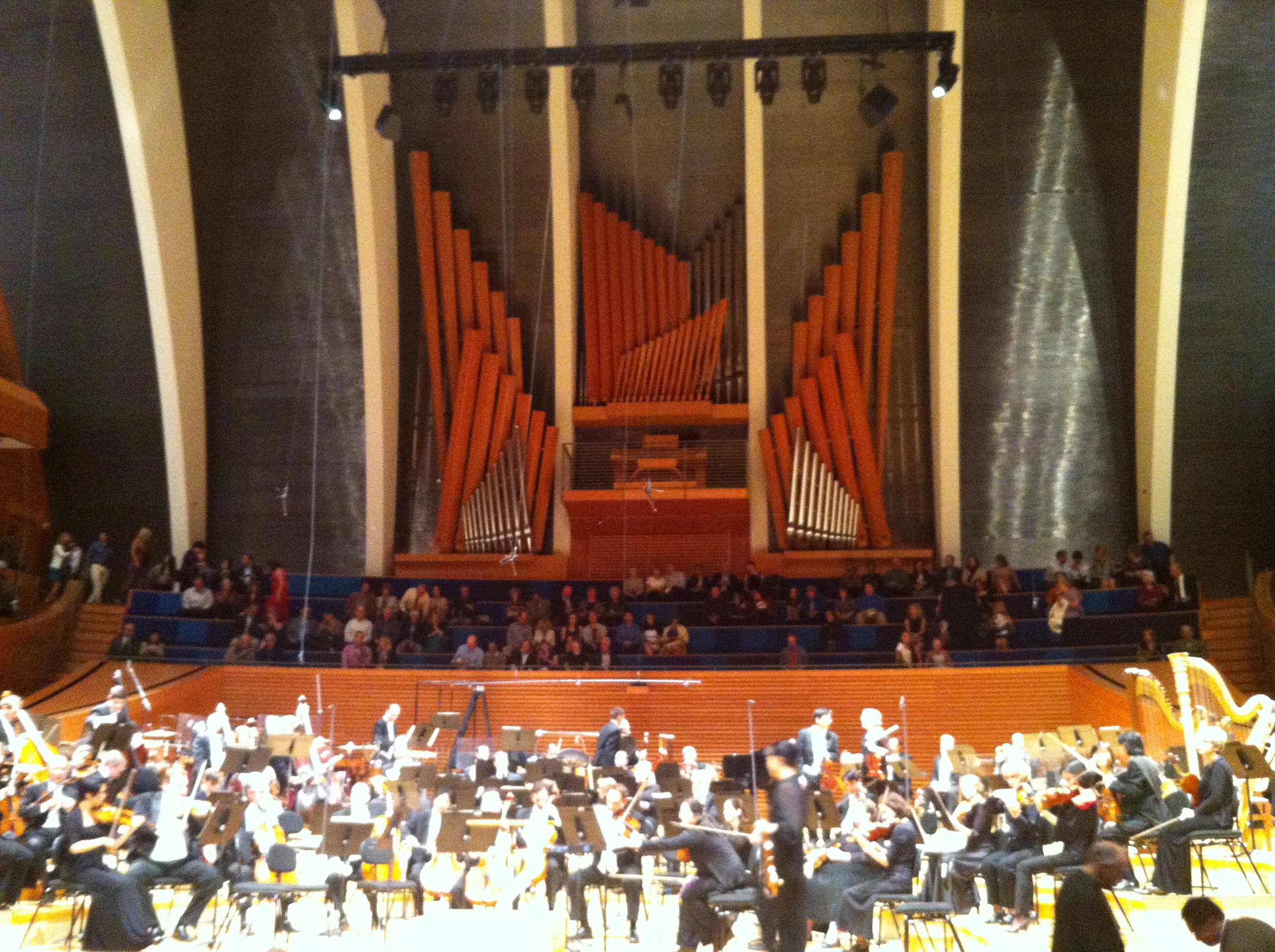
Helzberg Hall was buzzing with opening-weekend energy, and everyone, including the mayor of Kansas City, was in their seats early in anticipation of the music and acoustics of the amazing new Kauffman Center for Performing Arts. Music Director and Conductor, Michael Stern, fairly bounced onto the stage to announce the music for the evening, and suddenly we were on our way.
Composer-in-residence Adam Schoenberg’s relatively new piece, “Finding Rothko,” named for an exhibit of paintings in the MOMA in New York, was quite possibly the best classical work I’ve heard that has been composed in this young century. It’s melodic, powerful and somehow, at a mere sixteen minutes long, transcendent. This piece is not yet on iTunes, but when it becomes available I highly recommend it. The program liner notes say that Schoenberg is currently writing a new orchestration of “Pictures at an Exhibition.”
Vadim Gluzman was the guest violinist for Tchaikovsky’s “Concert in D Major, OP 35.” Gluzman played flawlessly and tirelessly, and without any apparent difficulty, as a joyful smile never left his face. Nor was he put off by the eruption of applause after only the second movement by the large throng of new subscribers who are learning to save their appreciation until the end of each piece – Gluzman simply stepped forward with his smile still firmly in place and raised a hand to quiet the audience. Mention must also be made of the exquisite oboe work of Kenneth Lawrence, and it was good to see him recognized by Michael Stern afterward. A standing ovation greeted Gluzman (at the appropriate time), and he played a Russian folk song as an encore.
Admittedly, prior to last night I was only familiar with Emerson, Lake and Palmer’s 1971 re-working of Modest Mussorgsky’s “Pictures at an Exhibition,” but the excitement by much of the audience after intermission had me wondering what to expect. Ravel’s orchestration is the standard, and from the moment the hall filled with the opening arrangement, it was clear that this was a work conductor’s like conducting, musician’s like playing, and audiences like tapping their knees to. It’s a complex piece, at times nearly bombastic, but it’s creative and playful, and surely requires repeated listenings to grasp all that is there. The finale, though, “The Gates of Kiev,” is so rich and testosterone-driven that it’s a shame to have to remain seated to hear it. Both the orchestra and the audience were so energized after the piece that Stern inserted Rimsky-Korsakov’s “Dance of the Tumblers” as a warm-down encore before everyone was invited into the atrium for a glass of champagne.
 berowne.com