Archive for Ralph McInerny

Bedtime Reading in Rome

Posted in Books, Family, Travel with tags , , , , , , , , , on July 9, 2015 by David McInerny

IMG_4952


The school year was 1969-1970, and I was in the third grade. My dad, having taken a sabbatical year from Notre Dame to do research in Rome, moved the entire family of eight for a year into a large apartment which we quickly made small with our numerous presence. The address has stayed with me for reasons I don’t know: Via Ugo Balzani 6. My little brother and sister slept with me in a bigger bedroom, with my sister on a single bed under the window. My three older sisters were scattered throughout the apartment. I have no idea where my parents slept… It was a magical year of learning another language, schooling with students from around the world, and traveling to places that I had never heard of. We had a tan VW microbus, manual shift, and my older sisters regaled us in that hippie van with the new Tom Jones cassette as well as a collection of top Italian pop hits, San Remo ’70, which was Italy’s answer to Woodstock that year.

My dad was writing what would become his first New York Times bestseller, The Priest, though at the time I only understood that he was holed up in a small closet with a typewriter day after day, and seemed very pleased with his progress. After dinner, we would go out on the street and play with the neighborhood kids with real names like Massimo, or made-up names like Blondie Boy because we couldn’t pronounce his real one, and dad would write until it was time for the “three little kids” to go to bed. While my mom checked the homework of the “three big kids,” dad watched us brush our teeth, tucked us in and pulled out one of several paperbacks he’s found at an English bookstore in Rome. Each night he would read us one chapter, first from Treasure Island, and later that year from Huckleberry Finn. We would beg for more than a chapter, even though dad often had to stop and explain the story lines to us, but it was one chapter only each evening. When those books were complete, he started writing his own series of children’s stories featuring Granny One-Tooth, her grandson Roy Boy and their friend Sheriff Omar. He wrote a chapter in the evening while we were playing and would read it as our bedtime story.

Dad continued the Granny One-Tooth series after we returned to Indiana, and in later years we would recall them and ask why he wouldn’t publish them. He always refused with a smile, and when he passed away those pages were never found among his voluminous writing. Today, when I think about two things I have adored my entire life – traveling and reading – there is no doubt how those passions were deliberately fostered by my parents. Living in Rome, traveling the European continent, nightly tales of running away and heading south down the Mississippi or across the ocean with pirates, all before the age of ten. I didn’t have a chance.
 

John Updike – The Henry Bech Series

Posted in Books with tags , , , , , , on August 18, 2012 by David McInerny

As prolific as Anthony Trollope, and as erudite as Hilaire Belloc, John Updike was a shining light in American writing, following in the epic literary footsteps of Hawthorne, Cooper, Melville, Twain and Steinbeck. He won every major book award available in the U.S., and the fact that he never won the Nobel prize for literature has nothing to do with not earning it, and everything to do with the silly political correctness of that erstwhile august institution.

His oeuvre includes twenty-four novels, seventeen volumes of short stories, ten volumes of the most eclectic collections of essays and criticism I’ve ever encountered, five children’s books, a play, his memoirs, and eight volumes of poetry, aptly culminating with the title, Endpoint. His fiction has itself spawned scores of scholarly works, and has made it to both the small and big screens.

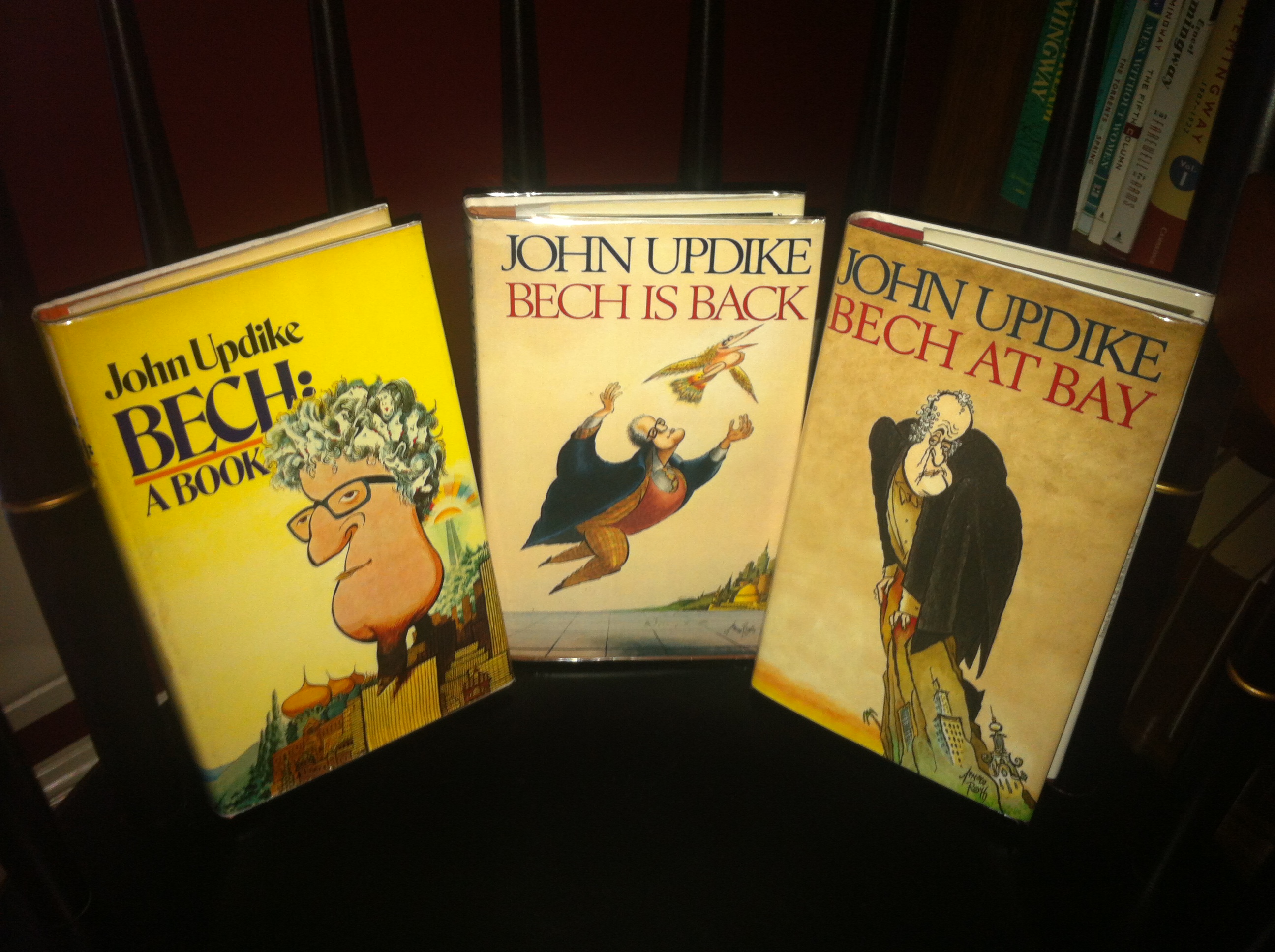
Angstrom Rabbit was the justified critical apex of Updike’s Rabbit series, but I’m much more partial to another serial creation of Updike’s – Henry Bech. The trilogy of Bech: A Book (1970), Bech is Back (1982), and Bech at Bay (1998) are an Updike poking fun at the world of writers and literary acclaim. It is some of his most amusing writing, at time approaching P.G. Wodehouse in it’s plausible ridiculousness. Henry Bech is a fiction writer on the downside of his writing career; in fact, he’s still living off the glories established with Kerourac-esque efforts written in his salad years. Throughout the books, Bech increasingly has to come to grips with the fact that, while he still pulls in a serious income on the speaking circuit, there is a widening body of critics that are deciding his best efforts have become dated. It’s not that Bech has lost his skills to write at this later point in his life; he just keeps getting distracted by an ever-aging camp of female groupies who, after a few months with him, decide he’s an old hat as well. Bech’s work is forgotten in America, but adored by fans in former Soviet bloc countries, ignored by his generation, but revered by college students. It’s an angst-ridden yin & yang for our protagonist, and it keeps him up at night (though rarely alone).

I’m reading the last book of the series, and I find it the best of the three books. Bech is forced to confront his critics in the United States and, worse, to converse with his peers who have continued to write successfully into their early dotage. The results are both hilarious and sometimes shocking, shock being an atypical tool of Updike. I won’t spoil it for you.

I encountered John Updike’s work when I was required to read The Centaur in Liz Christman’s creative writing class as a freshman at the University of Notre Dame. I appreciated his skill, but didn’t become hooked until I picked up The Witches of Eastwick (later a movie with Jack Nicholson and Cher), and wondered from where that kind of imagination came. I grabbed his books as soon as they were published, and I’ve been collecting his first editions for twenty-five years. I only lack two at this point, and I now search for them haphazardly, not wanting the project to end (yes, I know I could find them for a fortune tonight online, but I prefer to feel the rush of encountering them in a musty bookstore when I expect to find nothing at all). One of the prizes of my collection is a counterfeit copy of Bech: A Book, produced in China, even including a copyright page in Cantonese. Just the sort of adulation Henry Bech enjoyed outside of the U.S.

There are two chapters remaining to read in my book. I read a few pages at a time, savoring them, knowing there will be no more. At some point, too, there will be no more reason to enter a secluded specialty book shop in New Orleans who’s owner is an Updike fan, who entertained Updike in his store and, each year when I enter his shop says, “Here is the Updike man.” What a nice compliment. I love no American author more than John Updike … after Ralph McInerny, of course.