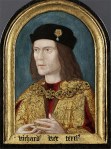
 Richard III is the first of Shakespeare’s histories that I’ve read (I thought it might be a good idea to begin to round out my experience beyond the comedies and tragedies, since I named this blog after a Shakespearean character), and I found the literary development of Richard a departure from almost every villain of any stature the great bard depicted. Granted, there was history to be followed, and the play was meant to be easy enough to follow in describing fairly recent English history to the masses, but Shakespeare had ample opportunity to infuse the flaws of Richard with the same tragic light as King Lear, or with the ultimate contrition and longing for redemption as Macbeth. Yet, there is none of that.
Richard knows who he is, knows what he wants, and attains it relentlessly. He is the ultimate poster boy for unrepentant ambition, and anyone in the play that even appears to stand in his way (and there are plenty) gets murdered be him or his close allies. And just to make sure there’s no double-crossing afoot, Richard knocks off the allies as well for good measure. Mothers, brothers, children, wives – no matter, they’ve got to go if they are an obstacle to the throne. Richard really wants to be the King of England.
The play describes the culmination of the War of the Roses, a royal “Hatfield’s vs. the McCoy’s” adventure between two English houses, that of Lancaster (symbolized by a red rose), and York (a white rose). Richard was from the house of York and, after assuming the throne, was defeated by Henry, Earl of Richmond (of the Lancaster line) who then became king and married Elizabeth of York to unite the families. With much bloodshed along the way.
After finishing the play, I did an internet search for connections between Machiavelli’s The Prince and Richard III. As I suspected, the comparisons are abundant. Richard’s ruthlessness is, of course, his undoing, since he goes to battle with conscripts and mercenaries, and all who could support him have no reason to , and wisely abandon him. In the battle he is knocked from his horse, leaving him exposed to the will of Richmond and his all too predictable fate. “A horse, a horse, my kingdom for a horse!”
 berowne.com